
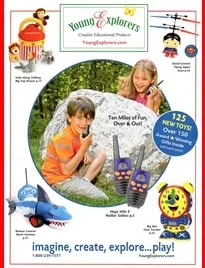
Young Explorers Toy Catalog
Parents often struggle to find meaningful ways to bridge the gap between entertainment and education during a child’s formative years. The Young Explorers Toy Catalog provides a specialized selection of items designed to stimulate cognitive growth while keeping young minds fully engaged in play. Unlike generic retail options, these products focus on high-quality materials and specific developmental milestones. Children naturally possess an innate curiosity about how the physical world functions, and providing the right tools can turn a simple afternoon into a profound learning experience. By choosing items that challenge logic and spark imagination, families ensure that playtime contributes to long-term academic and social success. From engineering sets to artistic endeavors, the variety available caters to diverse interests and learning styles. These thoughtfully selected resources help youngsters build confidence through hands-on discovery and problem-solving. This approach ensures that every gift serves a purpose beyond mere distraction.
Building Cognitive Foundations Through Scientific Discovery
Science kits and STEM-based activities represent a significant shift in how modern families approach playtime. These sets often include professional-grade components like real microscopes, chemical reaction chambers, or electronic circuit boards that teach fundamental principles of physics and biology. When a child assembles a working robot or grows crystals from scratch, they aren’t just following instructions. They’re developing critical thinking skills and learning the scientific method through direct trial and error. This hands-on interaction makes abstract concepts feel tangible and easier to grasp for growing brains.
Building sets and architectural toys take this development a step further by introducing spatial reasoning and structural integrity. High-quality blocks, magnetic tiles, and complex gears require users to plan ahead and visualize three-dimensional shapes. As kids stack, connect, and balance these pieces, they learn about gravity and weight distribution without even realizing it’s a lesson. These activities also improve fine motor skills and hand-eye coordination, which are essential for early writing and athletic performance. The satisfaction of completing a complex structure boosts self-esteem and encourages kids to tackle even bigger challenges.
Logic-based puzzles and strategy games offer a different kind of mental workout. These tools force players to consider multiple outcomes and anticipate the moves of others, which builds social intelligence and patience. Cooperative games are particularly effective at teaching teamwork, as participants must work together to reach a common goal rather than competing against one another. These interactions prepare young learners for classroom environments where collaboration is key. By engaging with these diverse resources, children develop a well-rounded skill set that serves them well into their teenage years and adulthood.
Essential Activity Sets for Growing Minds
- Interactive Science Kits: These kits allow students to conduct safe chemistry experiments or explore astronomy with telescopes, turning living rooms into functional laboratories for curious young scientists.
- Complex Building Sets: Precision-engineered blocks and mechanical gears challenge children to design intricate machines, fostering a deep understanding of basic engineering and physics through creative construction.
- Artistic Craft Stations: These sets provide high-quality paints, clay, and textile tools that encourage self-expression while refining fine motor skills and an appreciation for visual aesthetics.
- Strategy Board Games: Logic-centered games teach kids to think several steps ahead, improving their memory and ability to solve problems under pressure in a fun setting.
- Musical Exploration Tools: Real instruments scaled for smaller hands let youngsters experiment with rhythm and melody, which researchers link to improved mathematical reasoning and language acquisition.
Fostering Creativity and Physical Interaction
Creative play and artistic expression are vital for emotional development and stress relief in younger age groups. Engaging with arts and crafts allows kids to translate their internal thoughts into physical forms using paint, clay, or fabric. This process isn’t just about making something pretty; it’s about sensory exploration and learning how different textures and colors interact. Children who spend time creating art often show higher levels of concentration and a better ability to focus on detailed tasks for extended periods. It provides a quiet outlet for energy that balances out more active physical play.
Activity sets that focus on nature and the outdoors help connect kids with the environment around them. Gardening kits, bug-catching gear, and bird-watching guides encourage children to step away from screens and observe the natural world. This type of play fosters a sense of responsibility as they learn to care for living plants or respect wildlife habitats. It also promotes physical health by getting youngsters moving and exploring their local parks or backyards. Understanding the cycles of nature provides a solid foundation for future environmental science studies and a lifetime of outdoor appreciation.
Music and sound-based play contribute significantly to auditory processing and linguistic development. When children experiment with percussion, keyboards, or stringed instruments, they learn to recognize patterns and tonal shifts. This awareness translates directly to better phonemic awareness, which is a key component of learning to read and write. Beyond the academic benefits, music offers a way for kids to communicate feelings that they might not have the words for yet. It creates a joyful atmosphere that encourages movement and dance, rounding out a child’s sensory experience in a very holistic way.
Investing in high-quality educational resources ensures that a child’s free time remains productive and enriching. By prioritizing tools that challenge the mind and excite the spirit, caregivers provide a pathway to lifelong curiosity. The diversity of options available today makes it easy to find something that matches any child’s unique personality and interests. Whether they gravitate toward the precision of a chemistry set or the freedom of a blank canvas, the right choice makes all the difference. Accessing a Young Explorers Toy Catalog gives families the advantage of finding these specialized items in one convenient place. Choosing gifts that inspire growth is one of the most impactful ways to support a child’s future potential. Check out the latest Young Explorers Toy Catalog